Very Bad History
What John Trumbull’s famous painting gets wrong—and why accuracy still matters

One of my favorite depictions of the Founding era is the 2008 HBO seven-episode miniseries John Adams, based on David McCullough’s book. The writers take a few liberties with the historical timeline and there are some inaccuracies along the way, but as entertainment it’s well received—and Paul Giamatti’s portrayal of John Adams is nothing short of perfect.
Episode 2, “Independence,” will always be my favorite. But one of the most memorable scenes for me comes in Episode 7, “Peacefield.”
In that scene, an aging John Adams is joined by his son, President John Quincy Adams, as they view John Trumbull’s painting Declaration of Independence. Trumbull’s large work was commissioned by Congress in 1817, purchased in 1819, and eventually placed in the U.S. Capitol Rotunda in 1826—fifty years after the signing—meant to stand as a national tribute to the Revolution and the founding of the Republic. Trumbull is exuberant, proud, and clearly convinced he has created something monumental.
And then Adams, ever the curmudgeon, cuts right through it.
“All dead, except me and Jefferson,” he mutters, before dismissing the work as “very bad history.”
Adams is arguing—correctly—that Trumbull has chosen artistic license over historical accuracy. And I’ve always loved that moment, because it captures something real: the tension between how we remember history and what actually happened.
As I’ve mentioned before, I’ve walked through the Capitol Rotunda countless times over the years. I’ve stood beneath those paintings and looked up at Trumbull’s work more times than I can count. And every time, I’ve wondered the same thing: How bad is it, really? Is Adams just being Adams? Or is the painting actually misleading?
After doing a little research and taking a closer look, I have to admit—it pains me to say it, but I’m with President Adams.
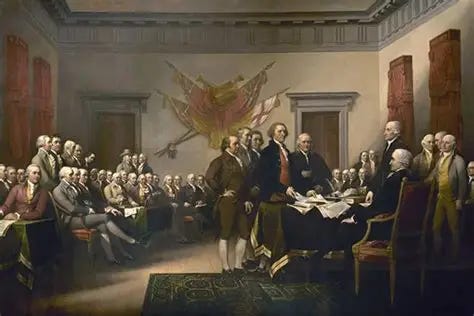
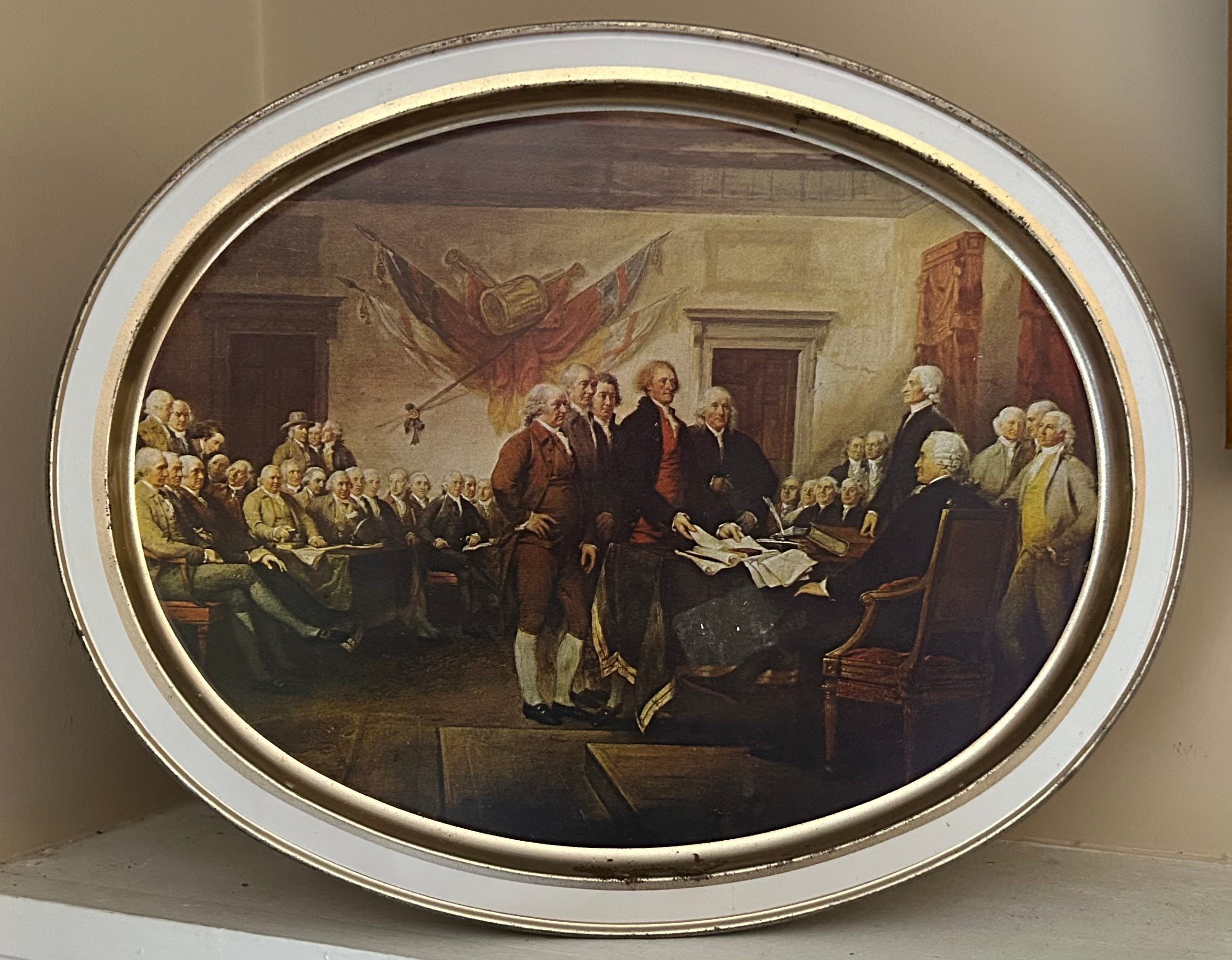
We all know this painting. It’s practically etched into the American imagination as the definitive image of what happened in Philadelphia in 1776. It depicts the Committee of Five—John Adams, Roger Sherman, Robert R. Livingston, Thomas Jefferson, and Benjamin Franklin—presenting their draft to John Hancock, who presides as President of the Continental Congress. Around them, the other delegates look on as though they’re witnessing the moment independence is declared in one grand, unified scene.
But according to Adams’ own recollection—and the broader historical record—this isn’t how it happened. The scene as shown didn’t occur on June 28, 1776. It didn’t unfold on July 2, when Congress voted for independence. It didn’t happen on July 4, when the final text was approved for publication. In other words, the painting captures a symbolic moment more than a real one.
Then there are the errors you can’t ignore once you see them.
We know there were 56 signers of the Declaration of Independence. Trumbull’s painting includes only 47 men. And of those 47, five aren’t signers at all.
Trumbull includes George Clinton and Robert R. Livingston of New York, Thomas Willing and John Dickinson of Pennsylvania, and Charles Thomson—Secretary of the Continental Congress. Livingston is especially notable: he was part of the Committee of Five, but he believed independence was premature and ultimately refused to sign. So, the painting includes him in the center of the action, while leaving out men who did sign and whose faces belong on that wall in the Rotunda.
And that choice matters. Because with those liberties taken, Trumbull excluded fourteen patriots—fourteen actual signers—who were essentially robbed of their place in posterity in the Capitol Rotunda:
Carter Braxton (Virginia)
Button Gwinnett (Georgia)
Lyman Hall (Georgia)
John Hart (New Jersey)
Francis Lightfoot Lee (Virginia)
John Morton (Pennsylvania)
Thomas Nelson, Jr. (Virginia)
John Penn (North Carolina)
Caesar Rodney (Delaware)
George Ross (Pennsylvania)
James Smith (Pennsylvania)
Thomas Stone (Maryland)
George Taylor (Pennsylvania)
Matthew Thornton (New Hampshire)
I still find the HBO scene profoundly ironic. It shows two men debating the need for historical accuracy, even as the miniseries itself plays fast and loose with certain facts. And it even stumbles within that very moment: Adams says everyone in the painting is dead except himself and Jefferson—which isn’t true. Yes, Adams and Jefferson famously died on the same day, July 4, 1826. But the last surviving signer was Charles Carroll of Maryland, who lived until 1832—six years after both Adams and Jefferson were gone.
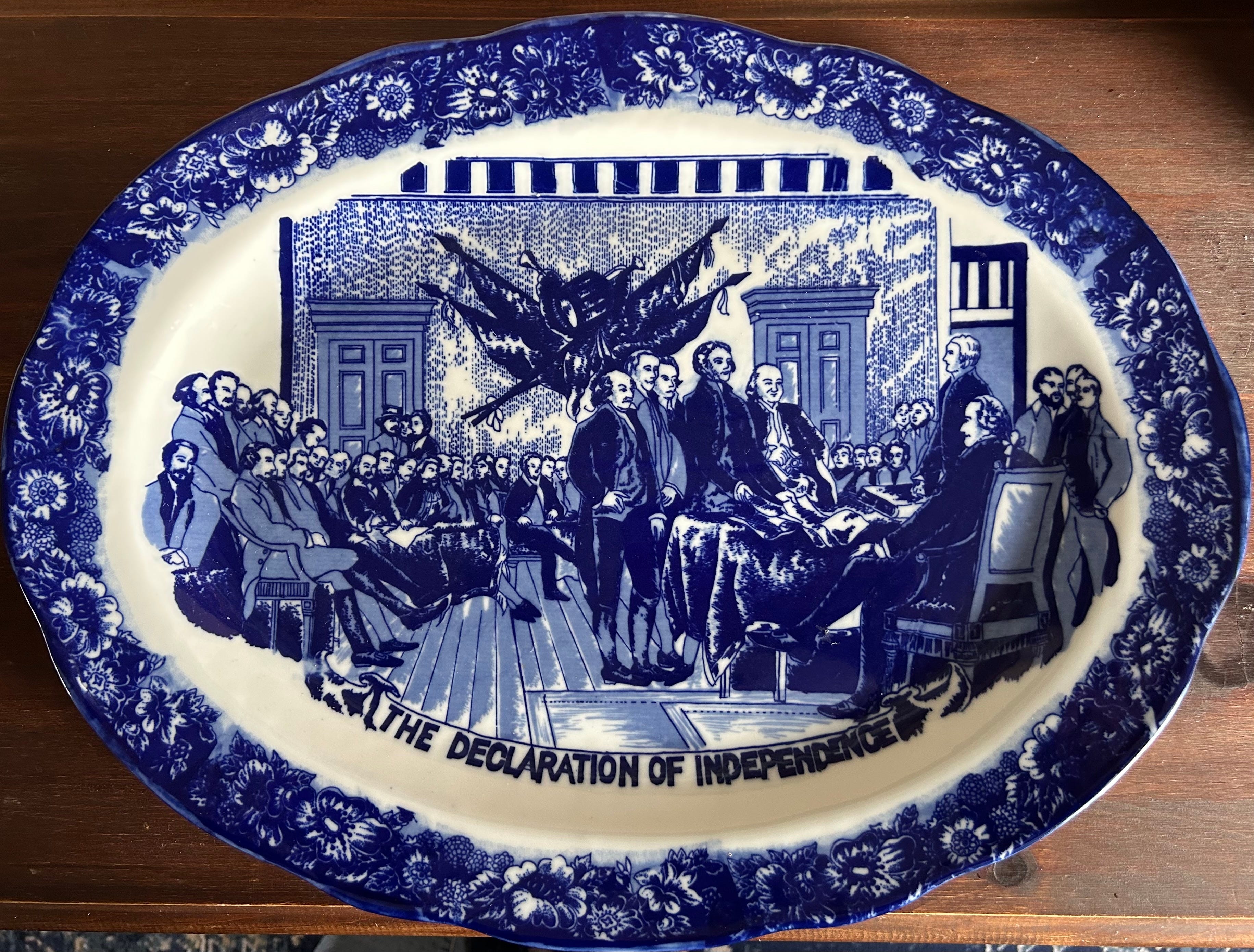
But maybe that’s the point. This is what history does when it becomes myth: it smooths out the messy parts, simplifies the timeline, and elevates certain names while quietly pushing others into the shadows. Trumbull didn’t give us a documentary snapshot—he gave us a national memory. And as powerful as that memory is, it also reminds me why I’m on this path in the first place. Because behind every familiar image are real men with real lives, real flaws, and real final resting places—some honored, some forgotten. My mission isn’t just to admire the story we’ve been told. It’s to go looking for the fuller story. And in doing that, I’m honoring the Founders—and keeping a promise I made to my dad—one name at a time.